


You can turn your small business into one that can change everything and make a game-changing impact for your business to get more sales growth step by step with Salesflare. Why Most Small Businesses Are Still Leaving Money on the Table
Picture this: It’s Tuesday morning. You’ve got 14 unread emails, three missed follow-up reminders written on sticky notes, and a spreadsheet that hasn’t been updated in two weeks.
Somewhere in that mess is a potential client who showed serious interest in your product last Thursday, and you still haven’t written back.
If you run a small business or work in sales, this kind of chaos is painfully common. And here’s the uncomfortable truth: it’s costing you real money.
Studies consistently show that the majority of sales happen after the fifth follow-up — yet most salespeople give up after just one or two attempts.
Not because they don’t care, but because they’re juggling too many things manually. They’re relying on their memory, scattered notes, and email threads that go back months.
In 2026, that approach just doesn’t work anymore. Buyers are smarter, more informed, and less patient.
Your competitors are already using tools that automate the boring stuff so they can focus on what actually matters: building relationships and closing deals.
That’s where CRM for small business automation comes in.
A modern, automated CRM is no longer a luxury reserved for large enterprises with dedicated sales teams.
It’s become an essential tool for freelancers, startups, agencies, and growing B2B companies of every size. And when it’s designed well, like Salesflare CRM, it practically runs itself.
In this guide, you’ll learn exactly what CRM automation is, why it matters in 2026, which features to look for, how it actually works step by step, and how to choose the right tool for your business.
By the end, you’ll have everything you need to stop losing leads and start closing more deals, with far less effort.
Let’s dive in.
Section 1: What Is a CRM for Small Business Automation?
Before we get into tactics and tools, let’s make sure we’re on the same page about what we’re actually talking about.
A Simple Definition (No Jargon)
CRM stands for Customer Relationship Management. At its core, a CRM is a system that helps you keep track of everyone you’re doing business with, prospects, clients, partners, and everything that happens in those relationships.
Think of it as a supercharged contact book that also remembers every conversation you’ve had, every email you’ve sent, every deal that’s in progress, and exactly when you should follow up next.
Automation means that instead of you doing all this manually, the CRM does it for you. It pulls in data, logs interactions, sends reminders, and even reaches out to contacts on your behalf, all without you lifting a finger.
Put them together, and you get a system that quietly handles all the administrative work of sales, so you can focus on the human parts: conversations, decisions, and relationships.
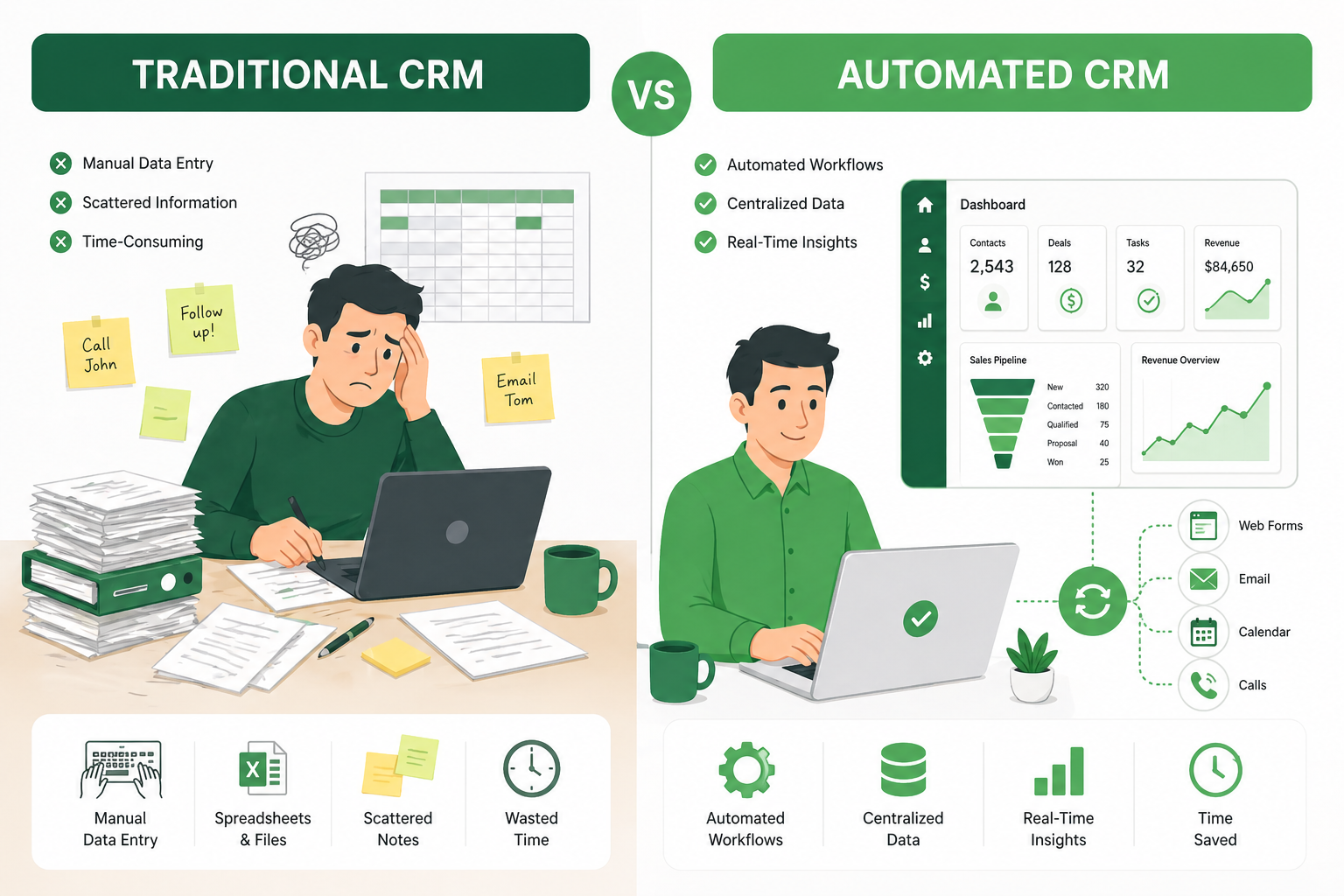
Traditional CRM vs. Automated CRM
Not all CRMs are created equal. There’s a big difference between older, traditional CRM platforms and modern automated ones.
Traditional CRM:
- You manually enter contact info after every call or meeting
- You have to remember to log emails yourself
- Reminders are set up by hand
- Reports require someone to pull data and build them
- Data goes stale quickly because nobody updates it
Automated CRM (like Salesflare):
- Contact info is pulled automatically from emails, LinkedIn, and calendars
- Every email, call, and meeting is logged without any effort from you
- The system reminds you when to follow up based on activity patterns
- Reports update in real time
- Data stays fresh because the CRM pulls it from live sources
The difference is enormous. Traditional CRMs require discipline to maintain, which is exactly why they often fall apart in small teams where everyone’s already stretched thin. Automated CRMs work for you, not the other way around.
Key Features of an Automated CRM
When we talk about CRM for small business automation, we’re specifically referring to a system that includes:
- Automatic contact enrichment — pulling names, job titles, company info, and social profiles
- Email and calendar sync — logging all interactions without manual input
- Pipeline management — a visual board showing exactly where each deal stands
- Automated workflows — sequences that send follow-ups, move deals, or alert team members
- Insights and analytics — dashboards that show performance without any manual reporting
When all of these work together, the result is a sales process that’s consistent, scalable, and most importantly, actually gets used.
Section 2: Why Small Businesses Need CRM Automation in 2026
You might be thinking: “I’ve managed fine so far without a CRM. Why do I need one now?”
Here’s why 2026 is different.
The Hidden Cost of Not Using a CRM
Every time a lead slips through the cracks, you’re not just losing a sale. You’re losing the time you spent generating that lead, the marketing dollars that brought them in, and the potential lifetime value of that customer relationship.
Research from HubSpot and various sales consultancies consistently points to the same problem: sales professionals spend a massive portion of their time on administrative tasks — updating spreadsheets, logging call notes, copying contact info between tools — instead of actually selling.
For small businesses, this problem is even more acute. You don’t have a dedicated admin team. You don’t have a full-time data entry person. Every hour you spend on busywork is an hour you’re not spending on growth.
And the leads you forget to follow up with? They don’t just sit around waiting. They move on to your competitor, who happened to email them at the right moment.
Buyers Expect Speed and Personalization
The modern B2B buyer in 2026 is more demanding than ever. According to multiple sales reports, buyers expect a response within hours, not days.
They also expect you to remember previous conversations. They don’t want to repeat themselves.
If you’re managing relationships through memory and spreadsheets, you’re going to fall short of these expectations, not because you’re not good at your job, but because it’s literally impossible to track all of that manually at scale.
CRM automation solves this by giving you instant context on every contact. Before a call, you can see the full history of every interaction in seconds.
You know what they bought, what they asked about, what objections they raised, and when you last spoke. That kind of preparation builds trust and closes deals.
The Competition Is Already Automating
Here’s the uncomfortable reality: your competitors are not sleeping on this. B2B companies of all sizes, from two-person startups to mid-market businesses, are adopting automated CRM tools at a rapid pace.
If you’re still doing things the old way, you’re not just falling behind — you’re falling further behind every month.
A Before-and-After Scenario
Let’s look at a concrete example.
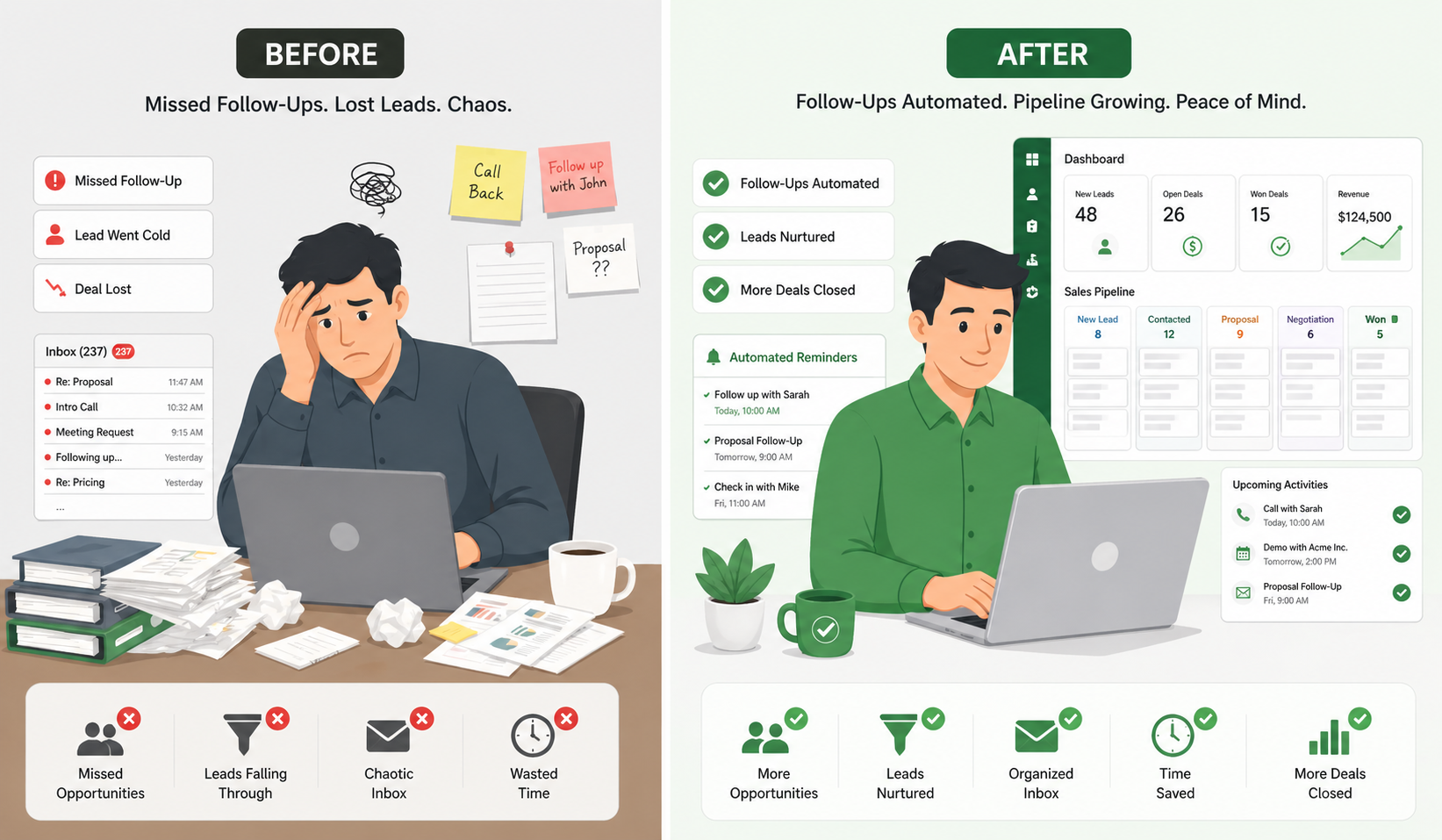
Before CRM automation, Alex run a small marketing agency. He tracks clients in a spreadsheet, takes notes in a notebook, and relies on his memory to follow up. He forgets to reach out to a potential client for two weeks after their initial call.
By the time he emails them, they’ve already signed with someone else. This happens more often than he likes to admit.
After CRM automation, Alex uses Salesflare CRM. When he has a call with a prospect, it’s automatically logged. Salesflare enriches the contact profile with their LinkedIn info and company details.
Three days later, when there’s been no reply to his proposal, Salesflare reminds him to follow up.
He sends a quick email, the prospect responds, and they close the deal that week. Alex didn’t have to think about any of it; the system handled the prompts.
That’s the power of automation applied to the sales process.
Section 3: Top Benefits of CRM Automation for Small Businesses
Let’s break down the specific benefits you’ll experience when you implement a well-designed automated CRM.
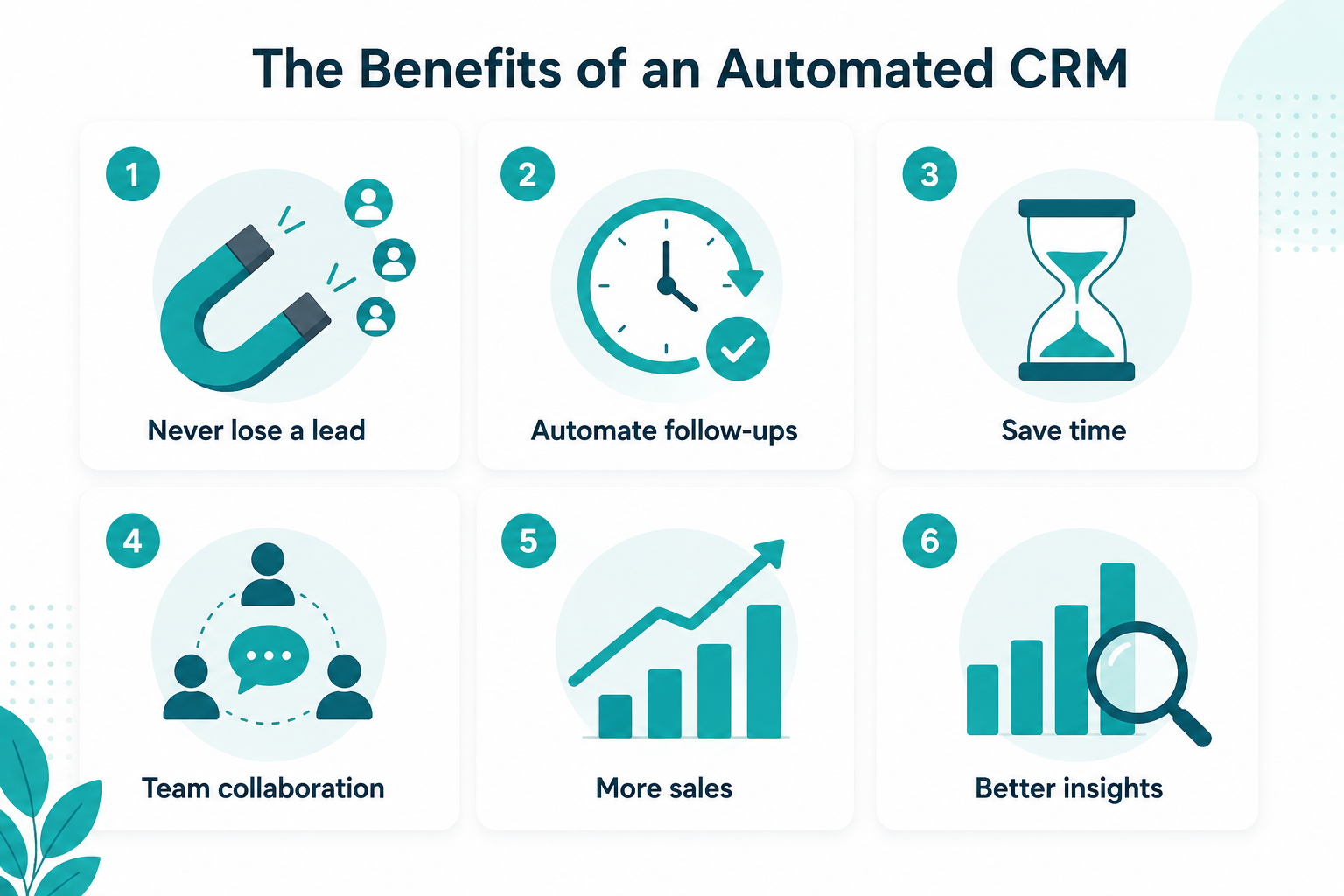
1. Never Lose a Lead Again
When every new contact is automatically added to your CRM, from email signatures, LinkedIn, business cards via mobile scan, or web forms, nothing falls through the cracks. Every prospect is tracked from the moment they enter your orbit.
Salesflare, for instance, automatically creates a contact profile based on email interactions and enriches it with publicly available data. You don’t have to do anything except have the conversation.
2. Automate Follow-Ups Effortlessly
One of the most powerful features of a good CRM is automated follow-up sequences. You can set up a series of emails that go out automatically based on triggers — like when a deal moves to a certain stage, or when a contact hasn’t responded in a certain number of days.
This means that even if you’re busy, your leads are never going cold. The system keeps the conversation alive until you’re ready to pick it up.
3. Save Hours Every Week
Think about how much time your team currently spends on manual data entry, updating spreadsheets, sending routine follow-up emails, and tracking who said what in which conversation. For many small businesses, this adds up to five to ten hours per person per week.
CRM automation eliminates most of that. When the system handles data collection, logging, and follow-up prompts, your team gets those hours back to focus on higher-value activities strategy, creativity, and actual selling.
4. Improve Team Collaboration
When all your customer data lives in one shared system that updates in real time, everyone on your team is on the same page. No more “wait, did you already call this person?” conversations. No more duplicated outreach. No more gaps when a team member is on vacation or leaves the company.
A shared CRM is also a powerful onboarding tool. When someone new joins the team, they can immediately see the full history of every account and get up to speed quickly.
5. Increase Sales Conversion Rates
Multiple studies across different industries consistently show that businesses using CRM tools close more deals than those without. The reasons are straightforward: better follow-up timing, more consistent outreach, and better insight into which deals are most likely to close.
When you can see at a glance which leads are hot and which are stalling, you naturally allocate your time more effectively. You focus on the opportunities that are most likely to convert, and you don’t waste energy on dead ends.
6. Better Customer Insights
An automated CRM gives you data that’s almost impossible to gather manually. You can see things like:
- Which email subjects get the most replies
- Which stage of your pipeline has the highest drop-off rate
- How long does your average sales cycle take
- Which lead sources produce the most closed deals
This kind of visibility lets you continuously improve your sales process. You can spot bottlenecks, double down on what’s working, and make smarter decisions based on real data rather than gut feelings.
Section 4: Key Features to Look for in the Best CRM for Small Business
Not all CRM tools are equal. Here’s what to look for when evaluating options.
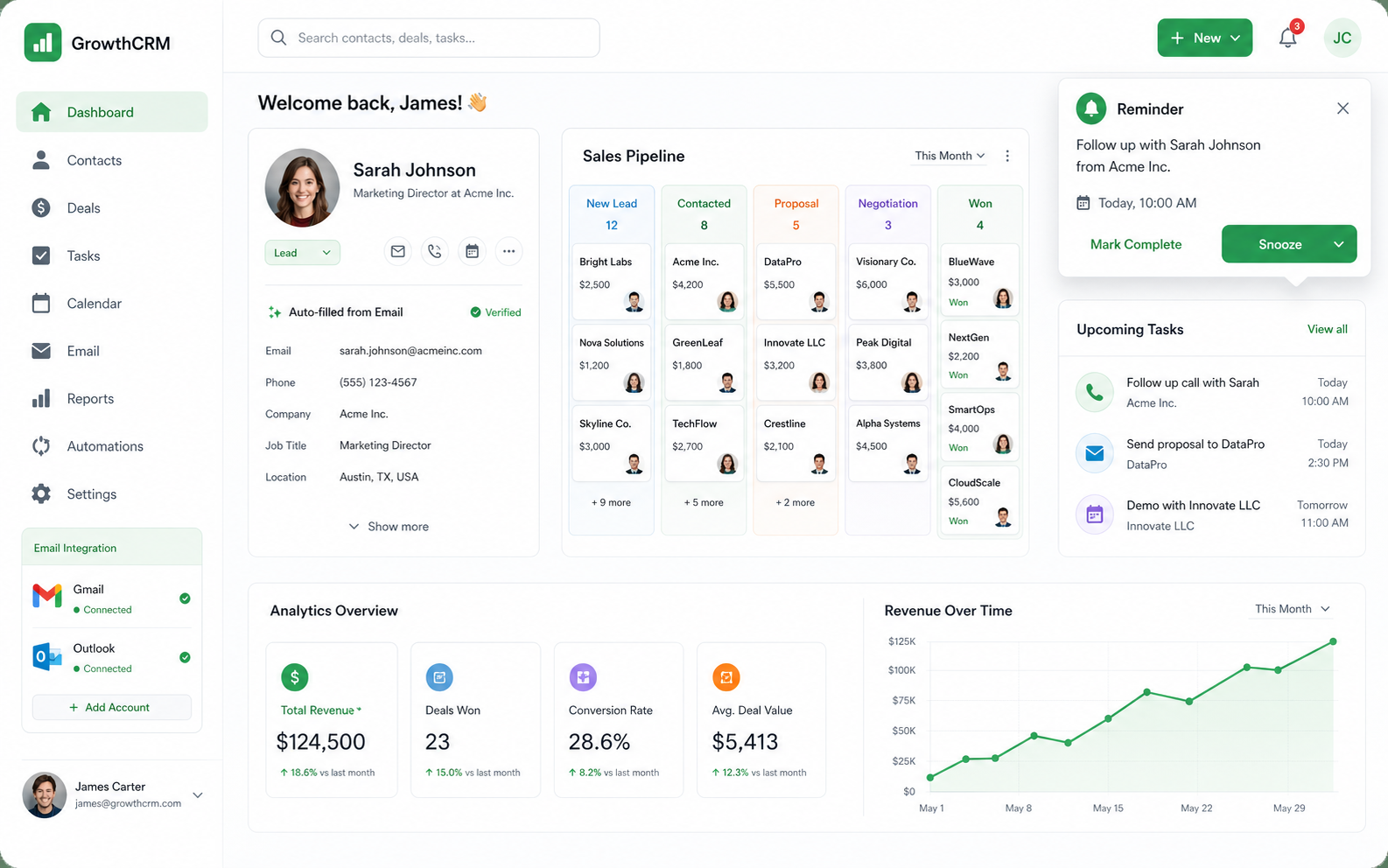
Email Integration (Gmail and Outlook)
Your CRM should connect seamlessly with the email client your team already uses.
This means every sent and received email is automatically logged against the relevant contact or deal, no copy-pasting, no manual logging.
Salesflare integrates natively with both Gmail and Outlook, and it also has a sidebar that shows you full contact context right inside your inbox without switching tabs.
Automatic Contact and Company Tracking
The best CRMs pull contact information from public sources and enrich profiles automatically.
Instead of you hunting down a prospect’s LinkedIn profile, phone number, or company size, the CRM does it for you.
This enrichment is particularly valuable for B2B sales, where understanding a prospect’s company,
their size, industry, funding stage, and recent news can make the difference between a generic pitch and a compelling one.
Pipeline Management
A visual sales pipeline lets you see every active deal at a glance. You should be able to:
- Create custom stages that match your actual sales process
- Move deals between stages with drag and drop
- See the total value of deals at each stage
- Spot deals that have been sitting too long without activity
Salesflare offers a clean, intuitive pipeline view that gives you an immediate sense of where your revenue is coming from and where the bottlenecks are.
Smart Reminders and Follow-Up Automation
This is arguably the most important feature for small businesses.
A good CRM should proactively tell you when to follow up with a contact, based on how long it’s been since your last interaction and where the deal stands.
Beyond reminders, look for automation workflows that can trigger follow-up emails automatically, not just remind you to send them manually.
Reporting and Analytics
You should be able to see performance metrics without building reports yourself. Look for dashboards that show pipeline health, conversion rates, revenue forecasts, and team activity at a glance.
Ease of Use and Adoption
This is often overlooked but critically important. The best CRM in the world is useless if your team doesn’t actually use it.
Overly complex tools with steep learning curves tend to get abandoned quickly, especially in small teams where there’s no dedicated admin to manage the system.
Salesflare was specifically designed with this in mind. Its philosophy is that a CRM should require minimal manual input and maximum automation, so that adoption happens naturally rather than being forced.
Section 5: How CRM Automation Actually Works (Step by Step)
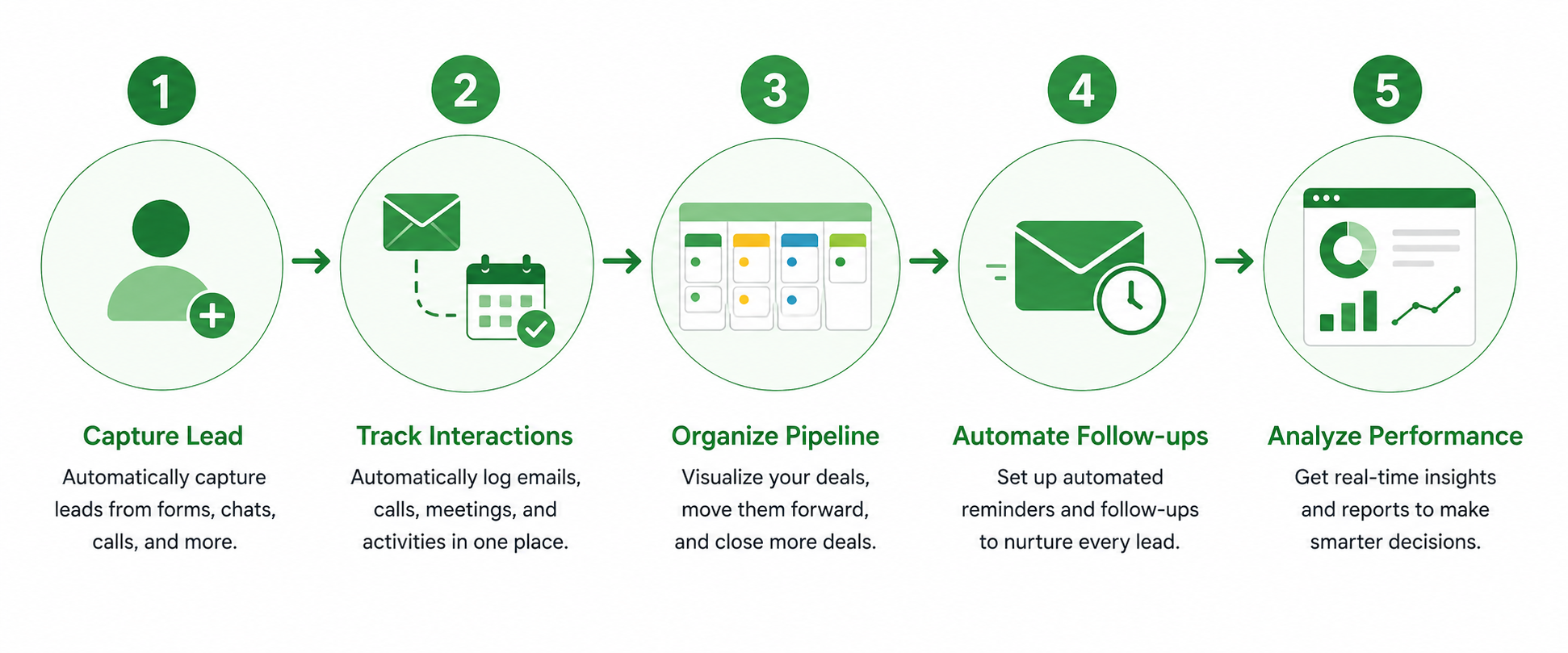
Understanding the technology helps you use it more effectively. Here’s a walkthrough of how CRM automation works in practice.
Step 1: Capture Leads Automatically
When someone fills out a form on your website, sends you an email, connects with you on LinkedIn, or gets mentioned in a forwarded message, an automated CRM can capture that contact and create a new record without any manual effort.
Salesflare, for example, detects new contacts from email interactions and suggests adding them to your CRM. It also pulls in their profile photo, job title, company, and social profiles automatically.
Step 2: Track Every Interaction
Once a contact is in your CRM, every interaction is logged automatically:
- Emails sent and received
- Meetings that appear on your calendar
- Calls logged via mobile app or integrations
- Website visits (if you have tracking enabled)
- LinkedIn messages (via browser extension)
This creates a complete timeline of your relationship with each contact that’s always up to date.
Step 3: Organize Your Pipeline
As leads progress from initial contact to proposal to close, you move them through your pipeline stages.
Some CRMs can even move deals automatically based on triggers, for example, when you send a proposal, the deal moves from “Qualified” to “Proposal Sent” automatically.
This keeps your pipeline accurate without requiring constant manual updates.
Step 4: Automate Follow-Ups and Sequences
Once a deal is in your pipeline, you can set up automated sequences that:
- Send a check-in email if there’s been no reply in three days
- Notify a team member when a deal reaches a certain stage
- Send a welcome email when a new contact is added
- Trigger a reminder when a deal has been in the same stage for more than a week
Salesflare’s email workflow feature lets you build these sequences visually and activate them with a single click.
Step 5: Analyze and Optimize
Finally, the CRM continuously collects data about your sales process and surfaces it in dashboards and reports. You can see:
- How many deals did you close last month
- Which deals are at risk of going cold
- How has your pipeline changed week over week
- Which team members are most active
This data loop — capture, track, automate, analyze — is what makes a CRM a genuinely transformative tool rather than just a glorified contact book.
Section 6: Best CRM Tools for Small Business Automation in 2026
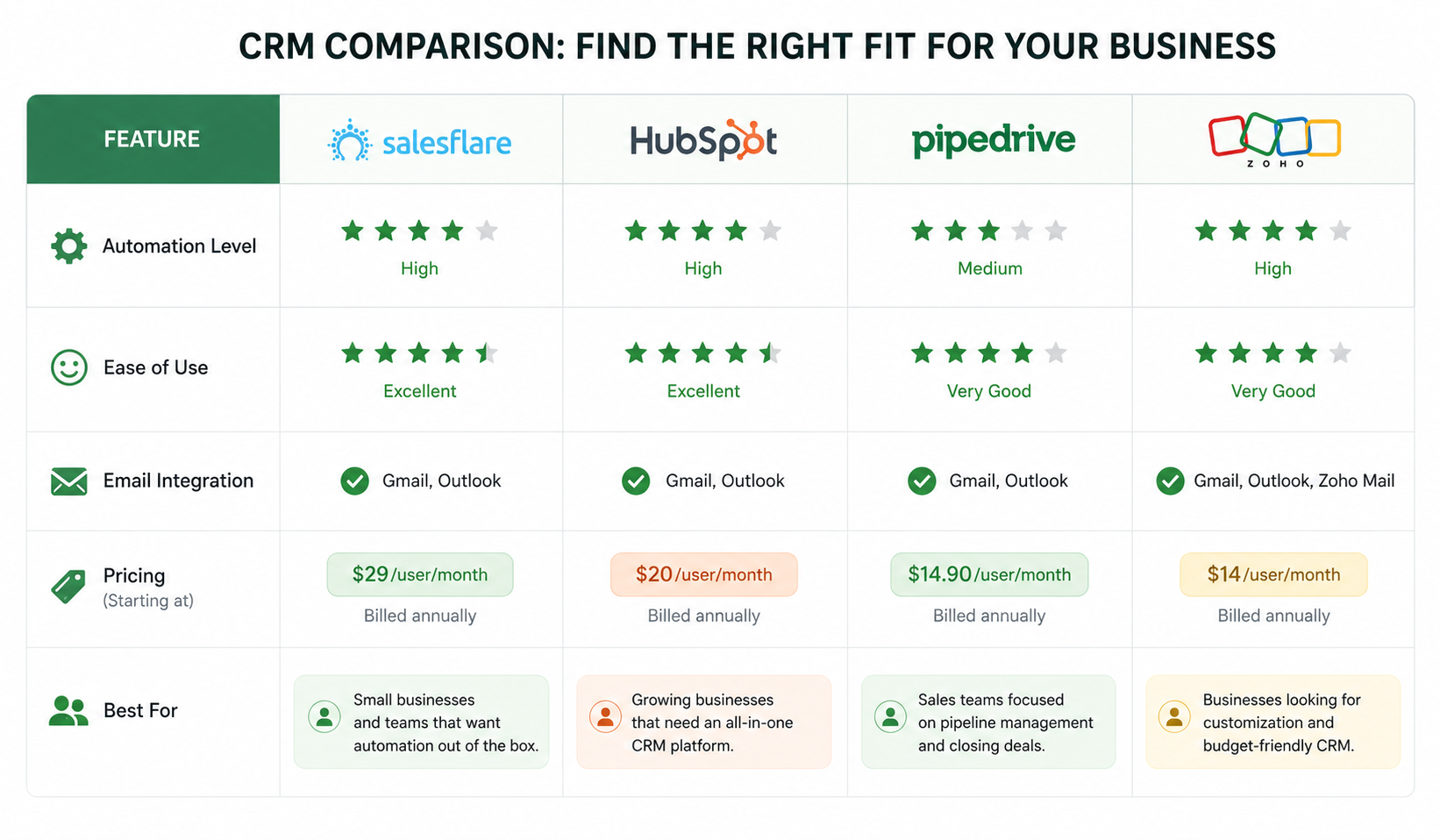
Let’s look at the top CRM options specifically for small businesses, with a focus on automation capabilities.
1. Salesflare CRM – Best for Automation and Simplicity
Salesflare is purpose-built for small B2B companies that want a CRM that works without demanding constant manual input.
Its core philosophy is “zero data entry” — the idea that a CRM should gather information automatically so salespeople can focus on selling.
What makes Salesflare stand out:
- Automatically logs all emails, meetings, and calls
- Enriches contact profiles from LinkedIn and public sources
- Built-in email sequences with open and click tracking
- Native Gmail, Outlook, and LinkedIn integration
- Clean pipeline view with drag-and-drop
- Proactive follow-up reminders based on inactivity
- Sidebar apps for Gmail, Outlook, and LinkedIn
- Mobile app for iOS and Android with full functionality
Salesflare is particularly well-suited to small and mid-sized B2B teams who do a high volume of outreach and can’t afford to spend time on admin work.
Its pricing is competitive and transparent, and the onboarding process is fast; most users are fully set up within a few hours.
Best for: Small B2B sales teams, startups, agencies, consultants
2. HubSpot CRM — Best Free Starting Point
HubSpot offers a genuinely useful free CRM tier that includes contact management, deal pipelines, email logging, and basic reporting. For teams just getting started with CRM, it’s a solid entry point.
The free version has significant limitations when it comes to automation. Most of HubSpot’s automation features, like workflow triggers, email sequences, and advanced reporting, are locked behind paid Marketing Hub or Sales Hub plans, which can get expensive quickly as your team grows.
Best for: Teams just getting started who need something free to begin with
3. Pipedrive — Best for Sales-Focused Teams
Pipedrive is built around the pipeline view, and it does that very well. It’s clean, intuitive, and designed specifically for salespeople rather than marketers or support teams.
The mobile app is excellent, and the activity-based selling philosophy resonates with teams that do a lot of calls and meetings.
Automation is available in Pipedrive, but requires add-ons for the more advanced features. It’s also less focused on automatically collecting data from emails and LinkedIn compared to Salesflare.
Best for: Sales-heavy teams who prioritize pipeline management
4. Zoho CRM — Most Affordable Full-Featured Option
Zoho CRM offers an impressive range of features at a lower price point than most competitors. It includes automation workflows, AI-powered lead scoring, and deep customization options.
The downside is complexity. Zoho CRM can be powerful, but it takes time to configure properly, and the learning curve is steeper than tools like Salesflare or HubSpot. For small teams without a dedicated CRM admin, this can be a barrier to adoption.
Best for: Budget-conscious teams willing to invest time in setup
Comparison Table
| Feature | Salesflare | HubSpot (Free) | Pipedrive | Zoho CRM |
|---|---|---|---|---|
| Starting Price | $39/user/mo | Free | $15/user/mo | $14/user/mo |
| Auto Email Logging | Yes (native) | Yes (limited) | Via integration | Yes |
| Contact Enrichment | Automatic | Manual/limited | Manual | Partial |
| Email Sequences | Built-in | Paid tier | Add-on | Yes |
| LinkedIn Integration | Native sidebar | Limited | Via Zapier | Via Zapier |
| Ease of Use | Very High | High | High | Medium |
| Best For | B2B automation | Getting started | Sales pipelines | Budget teams |
Section 7: How to Choose the Right CRM for Your Business
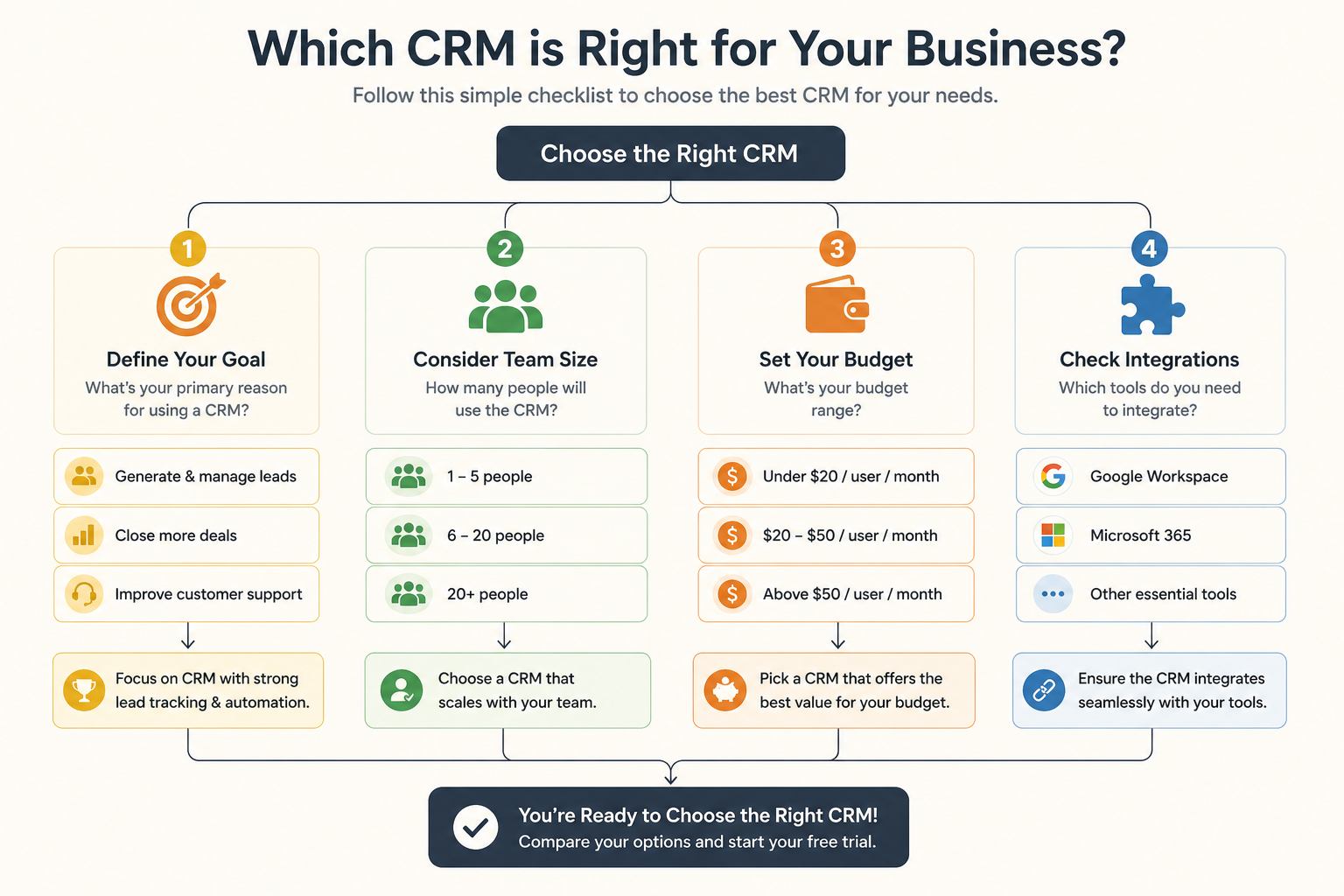
With so many options available, how do you actually make the decision? Here’s a practical framework.
Define Your Main Goal
Before comparing features, ask yourself: what’s the single most important problem I want my CRM to solve?
- If the answer is “I keep losing leads,” → prioritize automatic capture and follow-up reminders
- If the answer is “I don’t know where deals stand,” → prioritize pipeline management
- If the answer is “we spend too much time on admin,” → prioritize automation
- If the answer is “I need to understand my sales performance,” → prioritize reporting
Different CRMs excel at different things. Knowing your priority makes the decision much clearer.
Consider Your Team Size and Structure
A solo freelancer has different needs than a five-person sales team. If it’s just you, you need something simple that doesn’t require administration.
If you have a team, collaboration features, shared pipelines, and team activity tracking become important.
Also, think about the technical comfort level. If your team isn’t particularly tech-savvy, the simplest tool that does the job is almost always the right choice, because adoption will be higher.
Balance Budget Against Long-Term Value
It’s tempting to start with the cheapest option, but consider the real cost of a tool that doesn’t get adopted or doesn’t do what you need. If a better tool saves each salesperson five hours a week, the productivity gain often far outweighs the price difference.
That said, you don’t need to spend a fortune. Salesflare, for example, is priced competitively for the features it offers and doesn’t charge extra for the automation features that are most valuable to small B2B businesses.
Test Before You Commit
Most reputable CRM providers offer free trials of 14 to 30 days. Use this time to actually run your sales process through the tool not just poke around the interface.
Enter real contacts, move real deals through the pipeline, and send real follow-ups. That’s the only way to know if it actually fits your workflow.
Check Integration Compatibility
Your CRM needs to work with the tools you already use. Before committing, verify that it integrates with your email client, your calendar, your communication tools (Slack, Teams), and any other platforms that are core to your workflow.
Salesflare offers native integrations with Gmail, Outlook, LinkedIn, Mailchimp, Slack, and dozens of other tools, with additional connections available through Zapier and Make.
Section 8: Common Mistakes to Avoid When Using a CRM
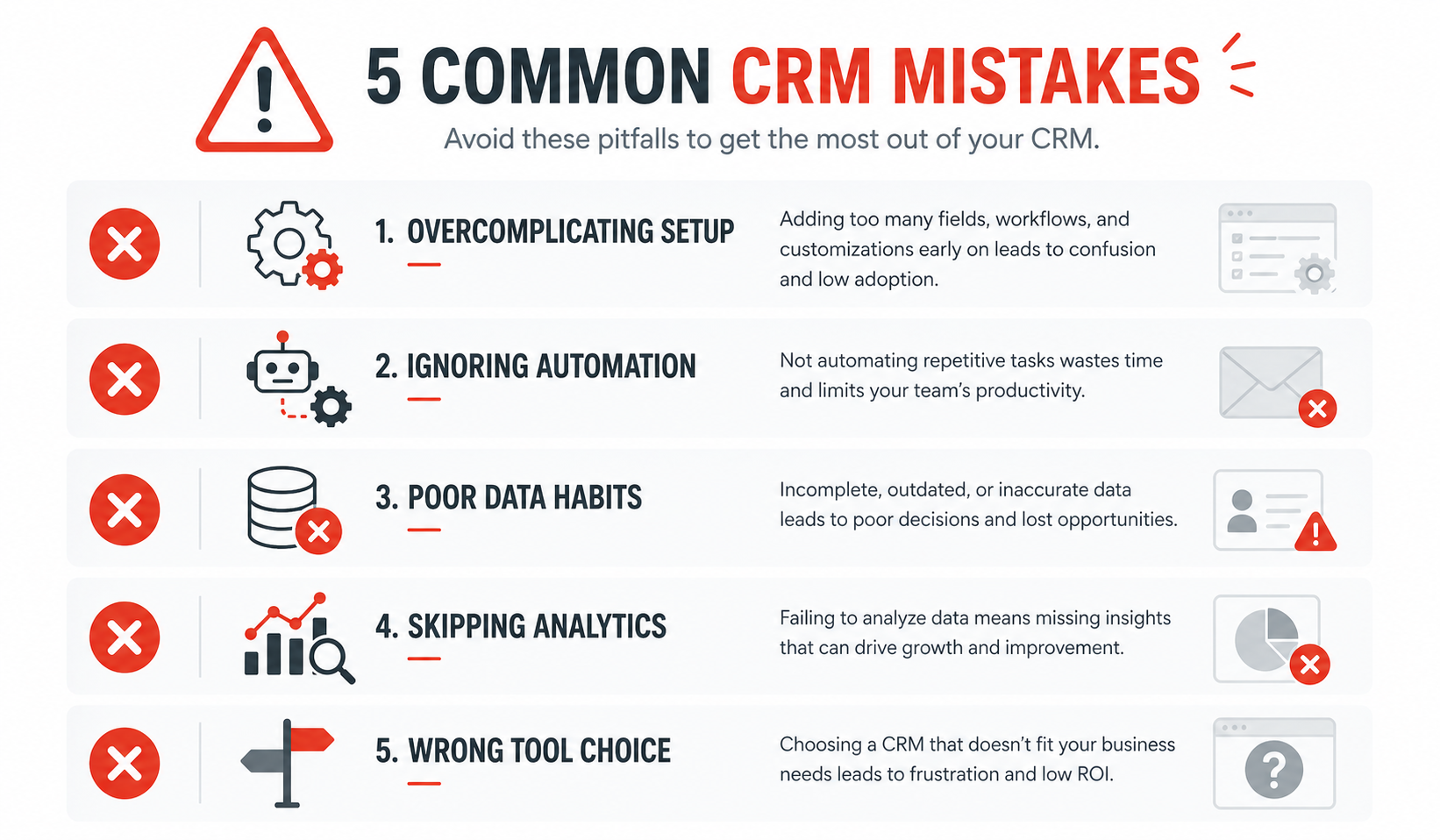
Adopting a CRM is a great step — but there are several common mistakes that prevent businesses from getting the full benefit.
Overcomplicating the Setup
It’s tempting to try to configure every field, stage, and automation before you’ve even started using the tool. This leads to analysis paralysis and delayed adoption.
Start simple. Set up your basic pipeline stages, connect your email, and start using it. You can refine and add complexity over time as you understand your actual needs.
Not Using the Automation Features
Many businesses adopt a CRM but use it purely as a contact database, ignoring the automation features entirely. This is leaving enormous value on the table.
Take the time to set up at least basic follow-up reminders and one or two email sequences. The time investment pays off very quickly.
Poor Data Entry Habits (for Non-Automated CRMs)
If you’re using a tool that requires manual data entry, the quality of your CRM data is only as good as the habits of your team.
Inconsistent or outdated data is worse than no CRM at all, because it creates false confidence.
This is one of the strongest arguments for choosing a CRM that automates data collection; it removes the dependency on human discipline.
Ignoring the Analytics
Your CRM is generating valuable data about your sales process every day. If you never look at the reports, you’re missing one of the most powerful benefits of the tool.
Even spending 30 minutes a week reviewing your pipeline health and conversion metrics can surface insights that meaningfully improve your results.
Choosing the Wrong Tool and Abandoning It
If you pick a tool that’s too complex, too expensive, or doesn’t fit your workflow, you’ll stop using it and then conclude that “CRMs don’t work.”
The problem isn’t CRMs. It’s that you chose the wrong one. Take the selection process seriously, use the free trial genuinely, and make sure your team is involved in the decision.
Section 9: Future Trends in CRM Automation (2026 and Beyond)
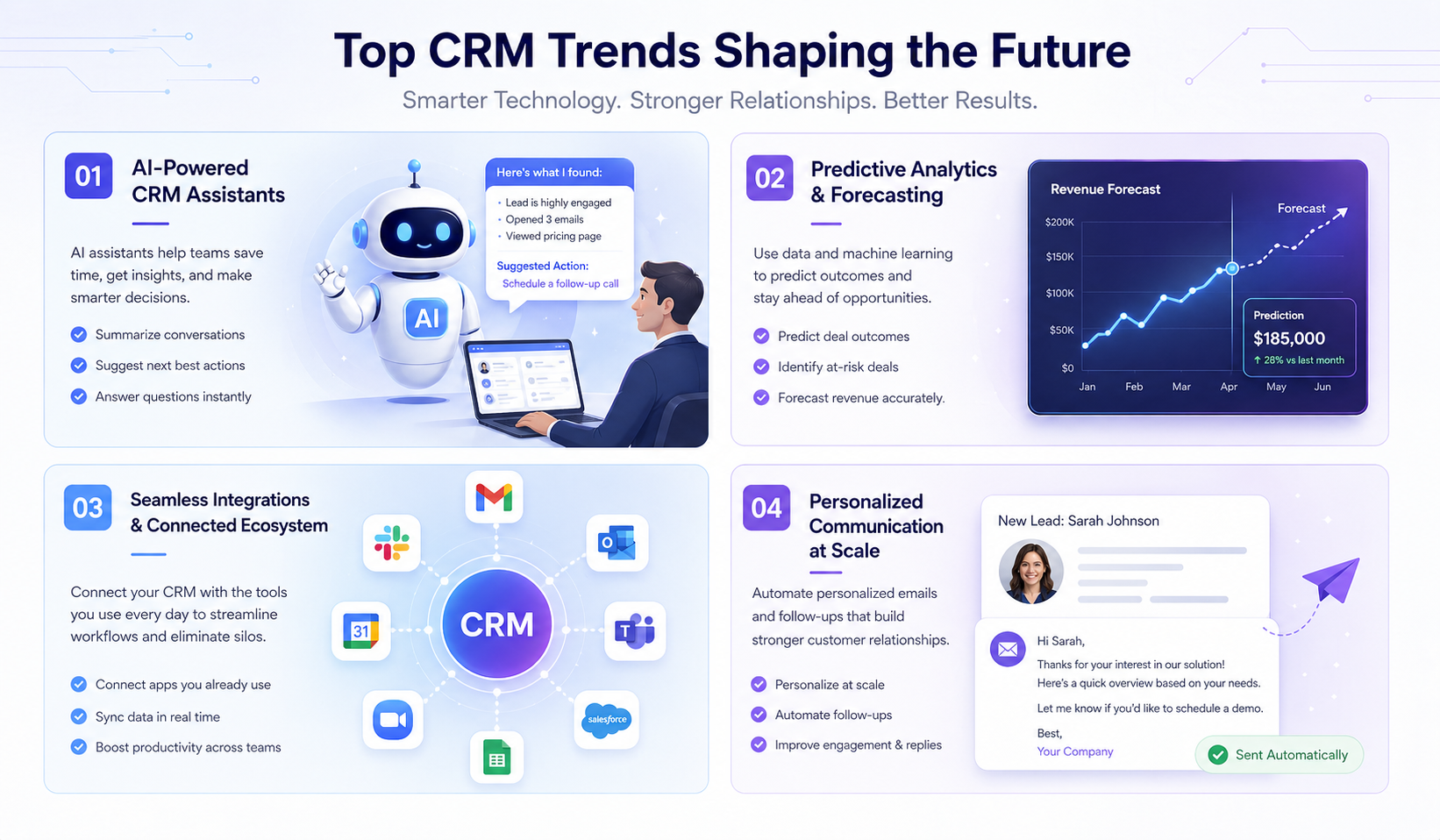
CRM technology is evolving rapidly. Here’s what to expect in the near future.
AI-Powered Sales Assistants
Artificial intelligence is being woven into CRM platforms at an accelerating pace. In practice, this means features like:
- Deal scoring , AI analyzes your pipeline and tells you which deals are most likely to close
- Conversation intelligence — AI analyzes email and call content to identify sentiment, objections, and buying signals
- Suggested next actions — instead of just reminding you to follow up, AI tells you what to say based on the conversation history
Salesflare is already incorporating AI features, and this trend will only accelerate in the coming years.
Predictive Analytics
The next frontier in CRM analytics is prediction rather than description.
Instead of showing you what happened last month, your CRM will predict what’s likely to happen next month, which deals will close, which are at risk, and what your revenue will look like at the end of the quarter.
This kind of forecasting was previously only available to large enterprises. In 2026 and beyond, it will become standard even for small business CRM tools.
Deeper Tool Integrations
The modern business tech stack is complex.
CRMs are increasingly becoming the connective tissue that links together email, calendar, video conferencing, accounting, customer support, and marketing platforms.
Expect richer native integrations and smarter data flows between tools.
Hyper-Personalization at Scale
As CRMs get better at capturing and interpreting customer data, they’ll enable increasingly personalized outreach at scale.
Instead of sending the same follow-up email to every prospect, you’ll be able to trigger personalized messages based on specific behaviors,
like visiting your pricing page, opening a proposal, or viewing a specific product.
This level of personalization, historically only possible with large teams, will become accessible to anyone using a modern automated CRM.
Section 10: Frequently Asked Questions (FAQ)
What is the best CRM for a small business?
The best CRM for a small business depends on your specific needs. For small B2B companies that want strong automation with minimal manual input.
Salesflare CRM is one of the top choices because it automatically logs emails, enriches contacts, and prompts follow-ups without requiring constant manual data entry.
HubSpot offers a solid free tier for teams just getting started, while Pipedrive excels for sales-focused teams that prioritize pipeline management.
How does CRM automation work?
CRM automation works by connecting your email, calendar, and other communication tools to a central system that logs interactions automatically.
When you send an email, it’s logged. When you have a meeting, it’s recorded.
Based on this data, the CRM can trigger automated follow-up emails, move deals through pipeline stages, and send reminders all without manual input from you.
Is CRM worth it for small businesses?
Absolutely. The return on investment from a CRM comes from two sources: time saved on administrative tasks and revenue gained from better follow-up and lead management.
For most small businesses, the productivity gain alone justifies the cost.
The revenue impact, from fewer lost leads and more consistent follow-up, often makes the ROI even more compelling.
Can CRM increase sales?
Yes, and the evidence for this is strong. Businesses that use CRM consistently tend to close more deals, maintain more consistent follow-up, and have higher customer retention rates.
The key is choosing a tool your team will actually use and then leveraging its automation features to make the sales process more consistent and reliable.
What is the easiest CRM to use?
Salesflare is frequently cited as one of the easiest CRMs to set up and maintain, primarily because it requires so little manual data entry. Most users can go from signup to a fully functional CRM in a few hours.
HubSpot’s free tier is also user-friendly, though it requires more manual input. The “easiest” CRM is ultimately the one that fits your existing workflow with the least friction.
Do I need a CRM if I’m a freelancer?
If you’re actively doing outreach, managing proposals, and following up with multiple clients at once, a CRM can absolutely benefit you even as a solo operator.
Tools like Salesflare have flexible pricing that works for individuals.
That is why you need to take a look at it and how it can help you turn your own business and why it is important to use and better your business to the next level.
The key question is whether you’re losing track of opportunities or spending time on admin that could be automated.
Conclusion: The Time to Automate Your Sales Process Is Now
Let’s bring it all together.
In 2026, CRM for small business automation isn’t a “nice to have”; it’s a competitive necessity. The businesses that are growing consistently are the ones that have found a way to stay organized, follow up reliably, and understand their sales data without burning out their teams on administrative work.
Make your business work well, not just by looking at what is not normal in your marketing and fixing it with salesflares, and putting everything in the right part
We’ve covered a lot of ground in this guide:
You now understand what CRM automation is and why it’s fundamentally different from traditional manual CRM tools.
You understand the real cost of not having a system,
in lost leads, missed follow-ups, and wasted hours. You know the specific features to look for, how to evaluate tools for your business, and which common mistakes to avoid.
Most importantly, you have a clear picture of what’s possible when your sales process runs on a system that works for you rather than demanding constant manual attention.
The next step is simple: pick a tool and start a free trial. Don’t wait until you have the perfect setup planned out. Start with your real contacts, run your real pipeline through it, and give it a genuine two-week test.
Salesflare CRM is a great place to start, especially if you’re a B2B business that wants strong automation with minimal friction. It’s built specifically for the kind of small, growing businesses that need to sell efficiently without hiring a dedicated sales ops team.
Your leads are waiting. Your pipeline is ready to be organized. Your follow-ups are ready to run on autopilot.
The only thing left is to start.
Want to learn more? Explore how Salesflare CRM can help your business close more deals — visit salesflare. to start your free trial.
And other ways you can make money online, a step-by-step guide. WATCH VIDEO NOW. You can just follow up with my affiliate marketing tutorials on how you can earn money by promoting other companies’ products or services and earn a commission.
So keep learning with ugodspower and don’t forget to leave me your comment in this post comment section, and what you have learned and understand by taking part in these surveys.